Shut Up and Squat: Why Keeping Your Home Workout Goals to Yourself Actually Works
You know the drill. You decide — really decide this time — that you're going to commit to working out at home. Three days a week, maybe four. You've got a plan, a space cleared out, and a YouTube playlist ready to go. And then, almost immediately, you tell someone about it.
Your coworker. Your spouse. You post something vague but motivated on Instagram. Maybe you even text a friend asking if they want to "keep each other accountable."
A month later? The playlist is untouched. The floor space is a laundry pile again. And somehow, everyone already kind of forgot you said anything.
Here's the uncomfortable truth: telling people about your home workout goals might be the very thing that's killing them.
The Weird Psychology Behind Goal Announcements
Back in 2009, researcher Peter Gollwitzer published a study that made a lot of self-help gurus quietly uncomfortable. His team found that when people share their intentions with others — and those others acknowledge them — the brain registers a kind of premature success. You get a small but real hit of satisfaction just from saying you're going to do something.
In plain terms: your brain partially rewards you for the announcement itself. Which means you're already a little bit done before you've done anything.
For gym-goers, this effect is partially offset by the social environment. People see you there. They notice if you stop showing up. There's a low-grade social pressure that functions as a backup accountability system.
But at home? Nobody sees whether you actually worked out. Nobody notices when Tuesday becomes a couch day. The announcement gave your brain its reward, and then the follow-through became optional with zero external reinforcement. You got the dopamine hit of being seen as someone who works out without breaking a single sweat.
Why Home Exercisers Are Especially Vulnerable
This isn't a knock on your willpower. It's actually a structural problem specific to training at home.
At a gym, your presence is visible. Your absence is, too. That creates a kind of ambient accountability that doesn't require any conscious effort. You don't need to tell anyone your goals because the environment does the tracking for you.
At home, the opposite is true. Your environment is private by design. No one's watching. No one's counting. That's part of what makes home workouts so appealing — but it also means the social accountability that people assume will help them is working with a much thinner safety net.
When you tell your friends you're going to do a 30-day home workout challenge, they're supportive for about a week. Then life happens, conversations move on, and your "accountability partner" hasn't asked about your burpees in three weeks. The social contract quietly dissolves, and so does your routine.
The Identity Trap
There's another layer to this worth understanding. When you publicly announce a fitness goal, you're essentially staking part of your identity on an outcome. "I'm going to get in shape" becomes, socially, a statement about who you are and who you're becoming.
That sounds motivating. But it creates a fragile foundation. The moment you miss a session — and you will miss a session, because life is chaotic and your living room is full of distractions — you're not just skipping a workout. You're experiencing a small identity threat. And the brain's natural response to identity threats is avoidance.
So instead of getting back on the mat after a missed day, you find reasons to delay. Then delay some more. The goal gets quietly abandoned not because you're lazy, but because returning to it means confronting the gap between who you said you'd be and who you've been.
Keeping your goals private sidesteps this trap entirely. A missed workout is just a missed workout — not a public failure.
What Actually Creates Commitment at Home
So if broadcasting your intentions backfires, what does work? A few things, and none of them require a single Instagram story.
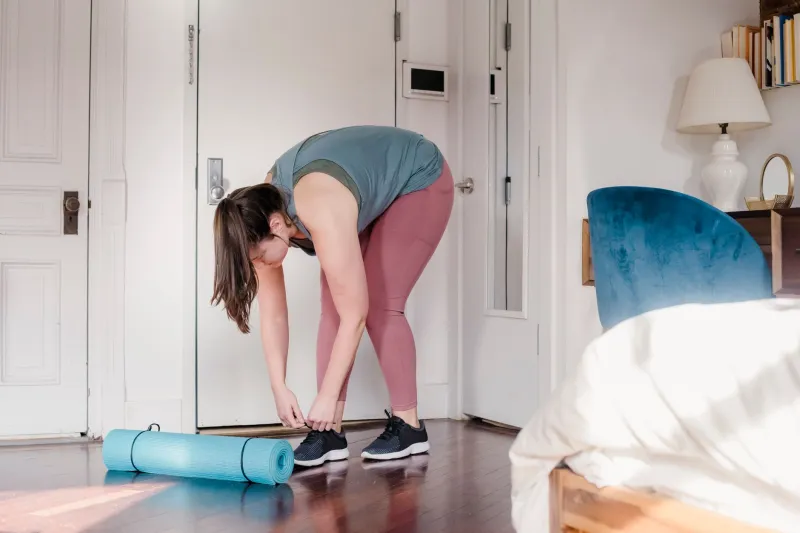
Build the environment before you build the announcement. Lay out your mat the night before. Set your workout clothes next to your bed. Put your water bottle by the TV. These physical cues signal intent to your brain without requiring external validation. The environment does the motivating — no audience needed.
Use "if-then" planning instead of public pledges. Research on implementation intentions — basically, pre-deciding exactly when and where you'll do something — consistently outperforms vague goal-setting. "I will work out at 7 a.m. in the living room after I make coffee" is dramatically more effective than "I'm going to start working out more." It's specific, private, and wired to an existing habit.
Track for yourself, not for an audience. A simple paper log or a notes app entry after each workout creates a personal record of momentum. You're not posting it. You're not sharing it. You're just building a streak that only you can see — and protecting it becomes its own quiet motivation.
Pick one trusted person, not a crowd. If you do want human support, resist the urge to broadcast. Instead, tell one person who genuinely cares about your follow-through — not someone who'll just hit "like" and move on. A single honest check-in partner is worth more than a dozen social media supporters.
Silence as a Strategy, Not a Secret
This isn't about becoming some brooding solo fitness monk who never talks about health. It's about understanding that the feeling of accountability and actual accountability are two very different things — and that the first one can trick you into skipping the second.
The goal announcement gives you a social reward upfront. Real consistency delivers its rewards slowly, quietly, and only to you. At home, where no one's watching anyway, learning to work for the private payoff is the skill that actually sticks.
So the next time you feel that urge to post about your new workout plan before you've done a single rep — pause. Lace up instead. Do the thing first. Then decide if it needs an audience.
Chances are, by the time you're a few weeks in and the habit is actually forming, you won't feel the need to announce it at all. And that's exactly when you'll know it's working.