Working Out Alone Doesn't Have to Mean Working Out Lonely
Somewhere around week three, it hits you. Not soreness. Not boredom. Something harder to name.
You're mid-set, staring at the same wall you've been staring at for weeks, and the silence feels less like peace and more like something pressing down on your chest. You finish the workout. You check it off. But you don't feel the way you thought you'd feel.
If that sounds familiar, you're not struggling with fitness — you're struggling with isolation. And it turns out, those two things are more connected than most training guides will ever admit.
The Social Side of Sweat Nobody Talks About
Here's something the home workout industry doesn't love to advertise: a huge part of what makes group fitness work has almost nothing to do with the workout itself.
When you show up to a spin class or a CrossFit box, you're tapping into something psychologists call social facilitation — the measurable boost in effort and endurance that happens when other people are present. You push harder. You rest shorter. You feel more accountable. Not because the exercises changed, but because the room did.
At home, that room is empty. And your nervous system notices.
Research published in the Journal of Sport and Exercise Psychology found that people who exercised with a virtual partner — even asynchronously — worked out significantly longer and rated the experience as more enjoyable than those who trained completely solo. The takeaway isn't that home workouts are inferior. It's that the human element matters, and it's something you can actually engineer.
Why Isolation Compounds Over Time
The tricky thing about solo training loneliness is that it's slow. It doesn't knock you out in week one. It accumulates.
You skip a Wednesday session and nobody notices. You have a rough month and there's no one to check in with. You hit a personal record and the only person who hears about it is your dog. Over time, the absence of social reinforcement starts to hollow out your motivation from the inside.
Jamie, a 34-year-old remote worker from Austin, described it this way: "I'd been working out at home for almost a year. On paper, I was consistent. But I felt like I was training in a vacuum. I wasn't quitting, but I wasn't really showing up either. I was just going through the motions."
That going-through-the-motions feeling? That's the loneliness loop in action — and the exit isn't a new program. It's connection.
Building Your People (Without Building a Commute)
The good news is that community doesn't require proximity. Here are the strategies that are actually working for home fitness enthusiasts right now.
1. Find an Accountability Partner Who Trains on a Different Schedule
This one surprises people. You don't need to work out with someone in real time — you just need someone who cares whether you did.
An asynchronous accountability setup is simple: you and a partner agree to text or message each other after every session. That's it. No synced schedules, no shared Zoom links. Just a check-in.
Marcus, a 41-year-old from outside Chicago, swapped daily workout photos with a coworker for six months straight. "We never worked out at the same time. But knowing he'd be sending his photo made me send mine. It sounds small, but it completely changed my follow-through."
The science backs this up. External accountability — even lightweight, low-tech accountability — significantly reduces the likelihood of skipping sessions.
2. Join a Virtual Fitness Community With Real Culture
Not all online fitness spaces are created equal. Reddit communities like r/bodyweightfitness and r/homegym have hundreds of thousands of active members posting progress updates, asking form questions, and celebrating each other's wins. Facebook groups organized around specific programs or training styles often develop tight-knit cultures that rival anything you'd find at a local gym.
The key is engagement. Lurking doesn't count. Post your workout. Ask a question. Comment on someone else's progress. Show up consistently in the digital space the same way you'd show up in a physical one.
3. Try a Live Virtual Class — Even Once
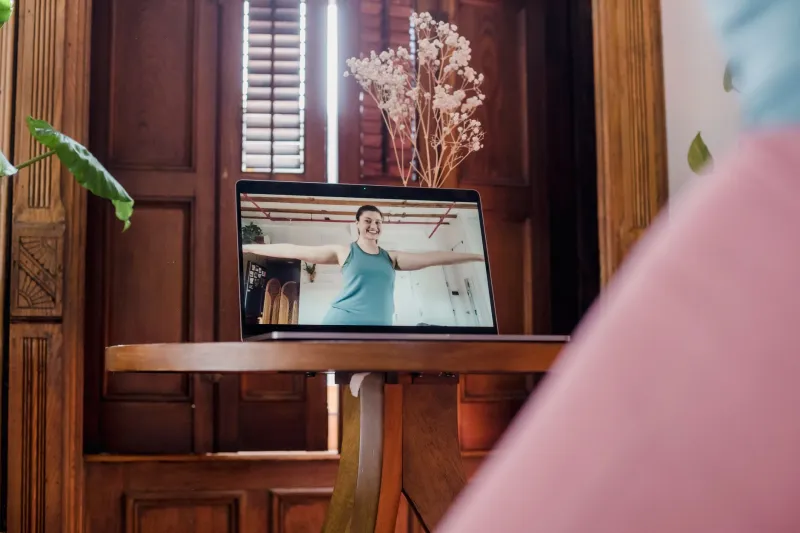
Platforms like Peloton, obé Fitness, and even Instagram Live workouts offer something that recorded videos can't: the real-time presence of other people sweating alongside you. The instructor knows you're there. The chat is moving. The energy is different.
You don't have to commit to a subscription to test this. Many platforms offer free trials, and plenty of fitness coaches host free live sessions on Instagram or YouTube. Show up to one and see how it feels.
Tanya, a 29-year-old from Portland, made the switch from recorded workouts to live virtual classes after months of feeling disconnected. "I thought I'd feel silly working out on camera, but I never even turn my camera on. Just being in a room — even a virtual one — where people are doing the same thing at the same time changed everything for me."
4. Create a Group Challenge With Friends or Coworkers
You don't need an app or a platform to run a fitness challenge. A group text works fine. Agree on a shared goal — thirty days of movement, a weekly step count, a monthly push-up total — and check in regularly.
The competitive element matters less than the shared context. When your friends are also doing something, your workouts become part of a larger story. You're not just exercising. You're participating.
5. Narrate Your Training Publicly
This one feels uncomfortable for a lot of people, but it works. Posting your workouts — even just to a small, private Instagram account or a fitness-specific social profile — creates a public record that generates social feedback.
Likes, comments, and occasional DMs from people who relate to your journey create a low-key but genuine sense of community. You're not performing for strangers. You're documenting for yourself, and connection happens naturally around that.
The Bigger Picture
Home fitness is genuinely incredible. No commute, no waiting for equipment, no judgment from strangers, no monthly fees eating into your budget. The freedom is real.
But freedom and connection aren't mutually exclusive. You can have the convenience of training at home and the motivational fuel of community — it just takes a little intentional engineering.
The loneliness loop is real, but it's not a life sentence. It's a design problem. And design problems have solutions.
Start small. Text one person after your next workout. Post one update. Show up to one live class. The community you've been missing doesn't require you to go anywhere — it's already out there, waiting for you to plug in.