No Drive, No Problem? Why Skipping the Commute Is Actually Costing Your Home Workouts

Rolling out of bed and into a workout sounds like the ultimate upgrade. No traffic, no parking, no awkward locker room small talk. Just you, your living room, and a clear schedule. On paper, the home gym experience should be easier to commit to than dragging yourself to a fitness center across town.
So why does it so often feel harder?
If you've ever stood in your home gym — or your cleared-out corner of the living room — feeling weirdly flat, unmotivated, and kind of like you'd rather just sit on the couch, you're not lazy. You're not undisciplined. You're just missing something your brain was quietly getting from that commute you gave up.
The Commute Was Doing Heavy Lifting You Never Noticed
Here's the thing nobody tells you when you cancel your gym membership: that 10-, 15-, or 20-minute drive wasn't wasted time. It was transition time. And your brain was using every second of it.
Psychologists call this a "threshold ritual" — a predictable sequence of events that signals to your nervous system that a shift in context is happening. You grab your bag. You get in the car. You maybe queue up a playlist or a podcast. You arrive at a place that only means one thing: exercise. By the time you're tying your shoes in the locker room, your brain has already started shifting gears. Cortisol and adrenaline are beginning to rise. Mental focus is sharpening. You're primed.
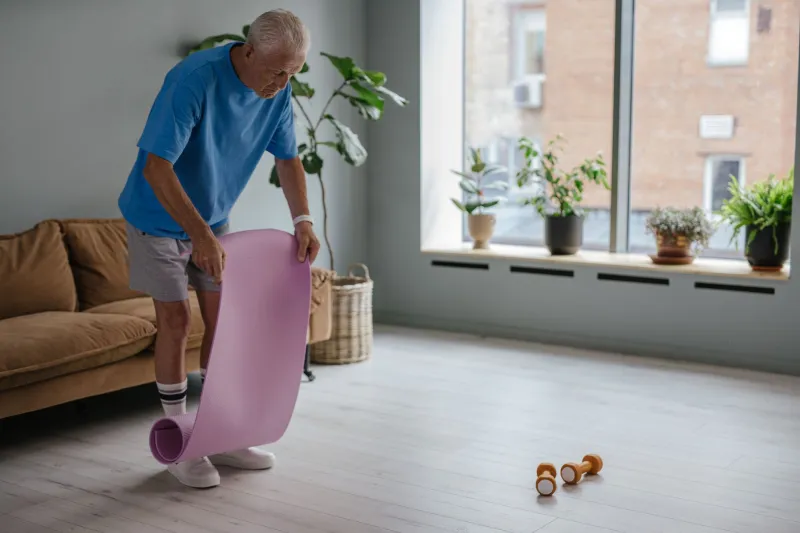
At home, you get none of that. You finish a work call, close your laptop, and — what? Walk fifteen feet to your garage? Your brain hasn't had time to switch channels. You're still half in work mode, half thinking about what's for dinner, and zero percent in training mode. And then you wonder why the first ten minutes of every home workout feel like wading through wet cement.
Why Your Brain Needs a "Gear Shift" Before Every Session
Neuroscience backs this up in a pretty compelling way. Our brains rely heavily on environmental and behavioral cues to shift between cognitive states. When the environment stays the same — home is home, whether you're working, relaxing, or training — those cues get muddy. The brain doesn't know which "mode" to load.
Elite athletes and high-performance coaches have understood this for years. Pre-competition routines aren't just superstition. They're deliberate neurological priming. A tennis player bouncing the ball three times before a serve. A basketball player's free-throw ritual. These behaviors aren't about the physical action — they're about telling the brain: we're doing this now, and we're doing it seriously.
Your commute was your version of that ritual. And without it, you're essentially trying to sprint before you've stretched.
What Elite Home Trainers Do Instead
The people who absolutely crush their home workouts — consistent, progressive, energized — aren't just more disciplined than you. They've figured out how to manufacture the mental transition that the commute used to provide.
Here's what that looks like in practice:
They change clothes in a specific way, in a specific place. Sounds almost too simple, right? But putting on your workout gear in the bathroom, away from your desk or couch, creates a small but meaningful physical act of transition. You're not just wearing different clothes — you're signaling a role change.
They have a dedicated "commute" playlist. Not their workout playlist — a separate, shorter playlist they only listen to during the five to ten minutes before training begins. The music isn't for lifting. It's for arriving. Over time, the brain starts associating those specific songs with incoming effort, and the neurological priming kicks in before you've done a single rep.
They physically leave and re-enter their space. This one sounds a little dramatic, but it works. Some serious home trainers actually walk outside — even just to the driveway and back — before starting a session. The act of leaving and returning creates a small but real psychological boundary between "regular life" mode and "training" mode.
They use a written warm-up script. Before touching a weight or hitting play on a workout video, they spend two to three minutes writing down what they're going to do and why it matters today. It's not journaling for the sake of journaling — it's a focusing tool that pulls attention away from everything else and directs it toward the session ahead.
Building Your Own Pre-Workout Commute
You don't need to overcomplicate this. The goal is to create a consistent, repeatable sequence of behaviors that you always do before training — and only before training. The specifics matter less than the consistency.
A solid artificial commute might look something like this:
-
Close out your work or leisure activity completely. Don't just minimize the browser tab. Close it. Put your phone in another room or flip it face-down. Create a hard stop.
-
Change into your workout clothes. Do this away from your training space if possible.
-
Spend five minutes in deliberate transition. This could be a short walk around the block, a specific playlist, five minutes of light stretching with eyes closed, or even a brief meditation. The content matters less than the consistency. Do the same thing every time.
-
Set a physical intention. Write down one goal for the session — not a life goal, just today's goal. "I'm going to hit all five sets of squats without skipping the last one." Simple, specific, actionable.
-
Enter your training space like you mean it. Step in, take a breath, and begin.
This whole sequence can take as little as eight to twelve minutes. Which, not coincidentally, is roughly how long a lot of gym commutes actually are.
The Bigger Picture
Working out at home is one of the best decisions you can make for your long-term fitness. The convenience is real. The savings are real. The ability to train on your schedule, in your space, without anyone watching you struggle through a new movement — genuinely valuable.
But convenience has a hidden cost if you're not careful. When everything is easy to access, nothing feels special. And your brain doesn't show up fully for things that don't feel like events.
The commute made going to the gym feel like an event. Your pre-workout routine needs to do the same job now. Build it deliberately, repeat it religiously, and give your brain the transition it's been missing.
You're already home. Now it's time to actually arrive.