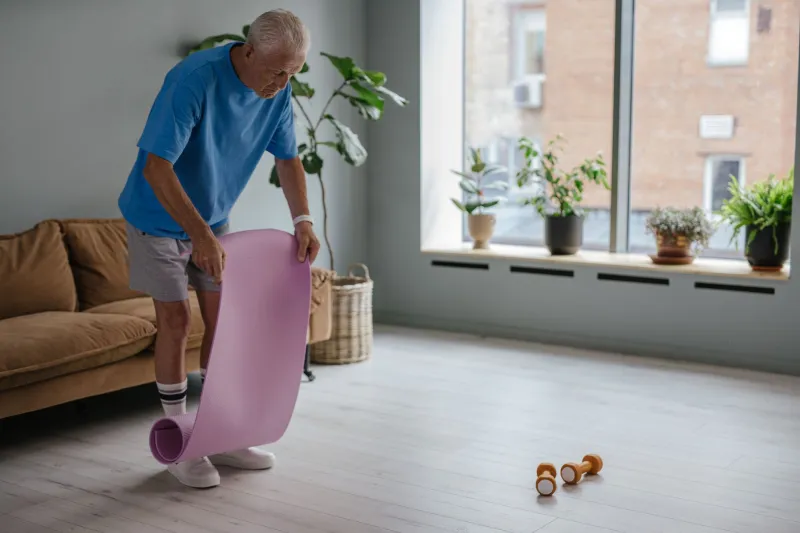
Three Months In and Running on Empty: What's Really Killing Your Home Workout Momentum

You were doing everything right. The alarm went off, you rolled out of bed, you hit play on the workout. For weeks, maybe two solid months, you were the person you always wanted to be — consistent, sweaty, proud of it.
Then month three showed up and quietly wrecked everything.
It didn't happen all at once. A skipped session here. A half-hearted effort there. Then one Tuesday you sat down on your yoga mat, stared at the ceiling, and genuinely couldn't explain why you should bother. Sound familiar?
This isn't a willpower problem. It's a deeply predictable physiological and psychological pattern — one that hits home exercisers especially hard. Understanding why it happens is the first step to actually doing something about it.
Your Brain Is Done Being Impressed
Early in a new workout routine, your brain is flooded with novelty. New movements, new soreness, new progress markers — all of it triggers dopamine releases that feel genuinely rewarding. You're learning, adapting, and your nervous system is firing on all cylinders just to keep up.
But here's the thing about dopamine: it's a response to change, not to consistency. By month three, your brain has catalogued the whole routine. It knows what's coming. The squat is just a squat now. The pushup is just a pushup. That neurological excitement you were running on? It's been quietly drying up since around week eight.
This is sometimes called hedonic adaptation — the brain's tendency to normalize repeated stimuli. At the gym, this gets partially offset by changing scenery, different equipment, and the unpredictable social environment. At home, you're working against a static backdrop that your brain stopped finding interesting around the time you memorized where the creaky floorboard is.
Your Body Isn't Struggling Anymore (And That's the Problem)
Adaptation fatigue is a different beast from the dopamine issue, but it hits at roughly the same time. In the first six to eight weeks of a new program, your body is in genuine survival mode — muscles are being broken down and rebuilt, cardiovascular capacity is expanding, your motor patterns are developing. All of that physiological drama makes workouts feel meaningful because they're genuinely hard.
By month three, your body has adapted. You're stronger, more efficient, more capable. Which sounds great — because it is — but it also means the same workout that used to leave you wrecked now feels like a warm-up. Without deliberate progression, you're essentially doing maintenance work and expecting transformation-level motivation. That math doesn't work.
The fix here is straightforward in theory: progressive overload. Add reps, increase resistance, shorten rest periods, or introduce more complex movement variations. But at home, without a full rack of dumbbells or a cable machine to dial up, this requires a little more creativity than it does at a commercial gym.
The Absence of Environmental Novelty Is Sneakier Than You Think
Research on exercise adherence consistently points to environment as an underrated factor in long-term motivation. Gym-goers get a steady drip of novelty — new faces, seasonal equipment rotations, the vague social energy of other people working hard nearby. Home exercisers get the same living room wall.
This isn't a knock on training at home — it's just an honest look at one of its structural challenges. Your environment stops sending signals that say this is a workout space once it becomes completely familiar. The psychological separation between "regular life" and "training mode" erodes, and with it goes some of the intentionality that makes workouts feel worth doing.
Small environmental resets can do a lot here. Rearranging your workout area, adding a single new element (a resistance band, a pull-up bar in a doorframe, even a different playlist rotation), or changing which room you train in can re-engage the brain's novelty response without requiring a complete overhaul of your setup.
Strategic Variation: The Antidote to Routine Staleness
The goal isn't to abandon your program — it's to introduce enough variation that your brain and body stay genuinely challenged. Think of it as a controlled disruption.
A few approaches that actually work:
Rotate your workout format every four weeks. If you've been doing straight sets, switch to supersets or circuit training. If you've been doing bodyweight exclusively, add a resistance band progression. The movements can stay similar; the structure should shift.
Introduce a "wildcard" day each week. Pick one session per week where you do something completely different — a yoga flow, a dance cardio video, a bodyweight HIIT routine from a new source. This keeps the week from feeling like a loop.
Set a micro-goal with a hard deadline. "Get stronger" is not a goal your brain can act on. "Do ten clean pull-ups by the end of next month" is. Specific, time-bound targets create a mini-motivation arc that can carry you through a rough stretch.
Community Connection Without Leaving Your Zip Code
One of the quieter losses in home fitness is the social element. You don't have a training partner showing up to hold you accountable. There's no group class instructor calling your name. The isolation that makes home workouts convenient can also make them feel weirdly lonely after a few months.
This is worth taking seriously. Studies on exercise adherence consistently show that social accountability is one of the strongest predictors of long-term consistency — more reliable, in many cases, than motivation or discipline.
The good news is that virtual community has gotten genuinely useful. Online fitness challenges, workout accountability groups on Discord or Reddit, or even just texting a friend your post-workout check-in can replicate enough of the social reinforcement to matter. It doesn't need to be elaborate. It just needs to be real and consistent.
Reframe the Goal Without Abandoning the Method
Sometimes the three-month wall isn't about the workout itself — it's about the goal you've been chasing feeling either too distant or already achieved. Both situations kill momentum in different ways.
If your goal was weight loss and the scale hasn't moved in three weeks, your brain starts doing a quiet cost-benefit analysis and landing on "why bother." If your goal was to "get in shape" and you've clearly gotten in better shape, the finish line disappears and motivation follows it.
The solution is goal layering. Keep a long-term outcome goal in the background, but build a series of shorter process goals in front of it. Not "lose twenty pounds" but "complete four workouts this week." Not "get fit" but "add five push-ups to my max by the end of the month." Process goals are things you can actually control on any given day, which makes them far more effective at sustaining daily behavior.
The Three-Month Mark Is a Test, Not a Verdict
Every home exerciser hits this stretch. The ones who come out the other side aren't more disciplined or more motivated — they're just better at recognizing the pattern for what it is: a normal physiological and psychological plateau, not a sign that home fitness isn't working for them.
Adjust the stimulus. Reset the environment. Connect with other people. Reframe what you're working toward. The living room is still your gym. You just need to remind your brain why that's actually a good thing.