Sweating Next to Someone Who Isn't: Navigating Home Workouts When You Share Your Space
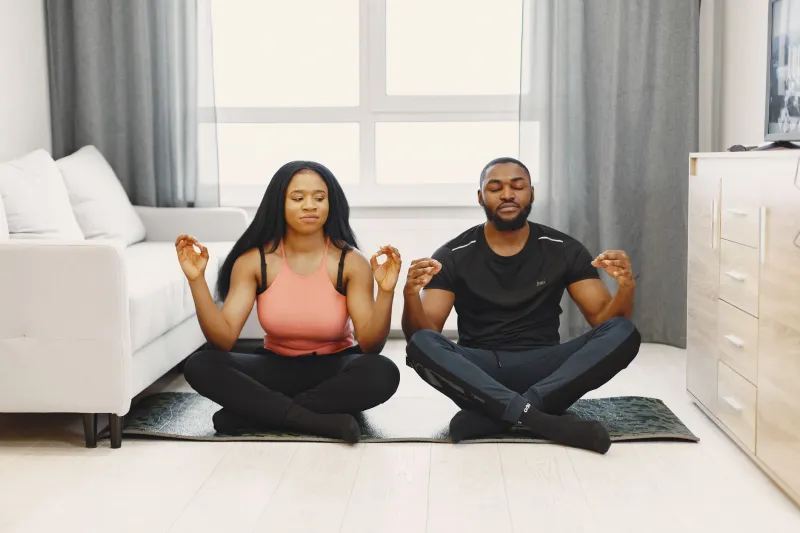
The Fantasy vs. The Reality
The home gym dream usually looks something like this: you, alone, focused, crushing a workout in your own space on your own schedule. No waiting for equipment, no locker room small talk, no commute. Just you and the work.
Then your partner wanders in wearing pajamas, pours a bowl of Lucky Charms, and sits down on the couch two feet from your yoga mat. They're not being rude. They live there too. But suddenly your perfectly planned 45-minute session feels like a performance — and not the good kind.
If you share your home with a significant other, you already know this tension. It doesn't matter how supportive they are or how much they respect your routine. The physical and psychological reality of working out in a shared space is genuinely different from working out alone, and pretending otherwise is why so many home fitness plans quietly fall apart.
Why It Feels Weird Even When Nothing's Wrong
Here's something nobody talks about: working out in front of your partner can feel oddly more uncomfortable than working out in front of strangers at a gym.
At a gym, everyone's sweating and grunting and making weird faces. There's a shared social contract that says we're all here doing awkward physical things and we agree not to make it weird. At home, that contract doesn't exist. Your partner is just... living their life. And you're over there doing reverse lunges and breathing like a freight train.
Psychologists call this social evaluation anxiety — the discomfort that comes from feeling watched and judged by someone whose opinion actually matters to you. Strangers at the gym are low stakes. Your partner? High stakes. Even if they're completely indifferent to your workout, your brain may interpret their presence as an audience, which shifts your focus outward and disrupts the internal concentration that makes training effective.
The result is that you rush through exercises, skip the awkward-looking mobility work, or cut the session short just to escape the invisible pressure. You're technically working out, but you're not really training.
The Negotiation Nobody Wants to Have
Beyond the psychological stuff, there's a practical problem: space and time are finite, and two adults with different schedules and different needs are constantly competing for both.
Maybe you like to work out at 6 AM and your partner needs the living room quiet because they work from home. Maybe your dumbbells are in the bedroom and your partner sleeps in on weekends. Maybe you've claimed the spare room as a home gym but it used to be storage and now there's resentment about the boxes you displaced.
These aren't small issues. Fitness research consistently shows that environmental friction — the small logistical obstacles that make starting a workout harder — is one of the biggest predictors of whether people stick with a routine. When your environment is shared, friction multiplies fast.
The fix isn't a single conversation; it's an ongoing negotiation that most couples handle by default rather than design. You silently adjust, they silently accommodate, and eventually one of you is quietly annoyed and neither of you knows exactly why.
Strategies That Actually Help
Claim a window, not just a space. Instead of saying "I work out in the living room," try "I need the living room from 6:30 to 7:15 on weekdays." A specific time window is easier for your partner to plan around than a vague territorial claim. Put it on a shared calendar if you have one. Treat it like a meeting neither of you would casually blow through.
Have the awkward conversation about visibility. This one's uncomfortable but worth it. Tell your partner directly that you work out better when you're not being watched — even casually. Most partners will completely understand and either leave the space or agree to stay focused on their own thing. What they can't do is accommodate a need you haven't expressed.
Design your workout to fit your shared reality. If total privacy isn't an option, stop fighting for it and start designing around it. Swap the exercises that feel most awkward under observation for ones that don't. Save the heavy lifting or the high-intensity stuff for the time of day when your partner is least likely to be in the room. Work with your actual environment instead of the ideal one.
Let go of the guilt trip you're giving yourself. A lot of home workout guilt runs in the opposite direction — you're sweating through a workout while your partner is relaxing, and some part of your brain interprets that as unfair. You're spending time on yourself. They're not. It feels indulgent in a way it wouldn't if you'd driven to a gym and been physically absent. But working out at home doesn't mean you owe your partner your workout time just because you're technically present. You're allowed to be in the same building and doing different things.
Create a signal, not a rule. Some couples do well with a simple physical cue — headphones in means don't interrupt, a closed door means this is workout time, even a small sign on the door. It's low-stakes but surprisingly effective. You're not laying down laws; you're just communicating without having to talk.
When Your Partner Wants In
Sometimes the challenge runs the other way. Your partner sees you getting consistent and wants to join in — which sounds great until you realize their fitness level, goals, and preferred workout style are completely different from yours. Now you're either modifying your own session to accommodate them or quietly resenting that your solo time got absorbed into couples time.
If you want to train together, great — but build a separate shared workout rather than merging theirs into yours. Protect your individual sessions as non-negotiable and add the joint workouts on top. Two people with different fitness goals trying to share one workout routine usually means both people end up with a compromised version of what they actually need.
Shared Space, Individual Goals
Living with a partner doesn't mean your fitness goals become a joint project. It also doesn't mean your workouts should constantly compete with the relationship for space, time, and emotional energy.
The couples who figure this out aren't the ones who have perfect home gym setups or perfectly compatible schedules. They're the ones who communicate clearly, negotiate honestly, and give each other room — literally and figuratively — to do the work.
Your home is shared. Your goals don't have to be.