Scrolling Your Way to Self-Doubt: How Gym Content Is Quietly Sabotaging Your Home Workouts
The Scroll That Derails Everything
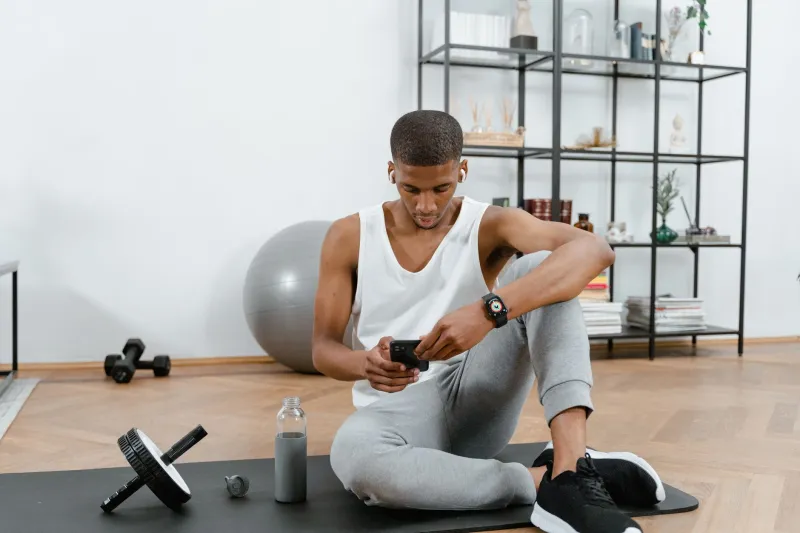
You just finished a solid bodyweight circuit in your living room. Legs burning, heart rate up, genuinely proud of yourself. Then you open Instagram for thirty seconds and suddenly you're watching someone deadlift 400 pounds in a gleaming commercial gym with perfect lighting and a hype playlist bumping in the background.
And just like that, your workout feels small.
This isn't a willpower problem. It's a comparison problem — and it's one of the most underrated reasons home workout momentum quietly collapses for so many people.
What the Research Actually Says
Social comparison theory, first introduced by psychologist Leon Festinger back in the 1950s, basically says humans are hardwired to evaluate themselves by measuring up against others. We do it constantly, usually without realizing it. And in the age of social media, that instinct gets weaponized.
A 2021 study published in Body Image found that exposure to fitness-related social media content was significantly associated with increased body dissatisfaction and reduced workout motivation — particularly when participants felt the content was out of reach or irrelevant to their own situation. In other words, watching someone crush it in an environment you don't have access to doesn't inspire you. It deflates you.
For home workout enthusiasts, this hits differently. You're already navigating a space that wasn't designed for training. You don't have squat racks, cable machines, or a dedicated training floor. When your feed is full of people who do, your brain starts running a comparison that was never fair to begin with.
The Gym Content Problem Is Specific — and Sneaky
Not all fitness content is created equal. There's a meaningful difference between watching someone do a killer resistance band workout in their apartment versus watching a shredded personal trainer cycle through a full commercial gym setup with equipment that costs more than a used car.
The problem isn't fitness content in general. It's the mismatch between what you're consuming and what your actual training environment looks like.
When there's a big gap between the content you watch and the reality you're working in, your brain starts to interpret that gap as a deficit. You're not just comparing bodies — you're comparing resources, access, and perceived seriousness. And that last part is the real killer. Somewhere in the back of your head, a voice starts suggesting that home workouts aren't real workouts. That you're playing a lesser game.
You're not. But your feed might be convincing you otherwise.
Why This Hits Harder When You're Already Making Progress
Here's the counterintuitive part: the comparison trap often bites hardest when you're actually doing well. You're a few weeks in, you're consistent, you're feeling stronger — and that's exactly when you're most vulnerable to outside input disrupting your internal sense of progress.
Psychologists call this "upward social comparison" — when you measure yourself against someone who appears to be doing better, achieving more, or operating at a higher level. In small doses, it can be motivating. But when it's constant and the gap feels unbridgeable, it shifts into something closer to learned helplessness. Why bother pushing hard in your garage if you'll never look like that guy with the Olympic lifting platform?
The answer, of course, is because your goals have nothing to do with that guy. But a curated feed doesn't care about your goals.
Curating Your Feed Isn't Quitting — It's Strategy
There's a tendency to feel like unfollowing certain accounts or muting certain content is some kind of defeat. Like you're admitting you can't handle it. That's backwards.
Controlling your information environment is a legitimate training strategy. Elite athletes do it all the time — they manage what they watch, read, and listen to because they know that mental inputs affect physical outputs. You're allowed to do the same thing.
Here's a practical approach to cleaning up your fitness feed:
Audit what you're actually watching. Spend one week paying attention to how you feel after consuming specific content. Does a particular account leave you energized or deflated? That's your data.
Follow home-based creators specifically. There are thousands of fitness creators who train exclusively at home, in small spaces, with minimal equipment. Their content will feel relevant to your reality instead of alien to it. Seek them out deliberately.
Mute, don't unfollow. If you're not ready to cut certain accounts loose, muting them is a low-drama middle ground. You won't see their content, but you won't have to make a whole thing out of it either.
Be honest about "inspiration" versus "comparison." Some content genuinely fires you up. Other content just makes you feel behind. Learn to tell the difference. If you finish a video feeling worse about your own training, that account isn't inspiring you — it's undermining you.
Build a Feed That Works Like a Training Partner
Your social media feed is part of your training environment whether you think of it that way or not. Just like a cluttered workout space or a bad playlist can tank your session, a feed full of content that makes you feel inadequate will quietly erode your confidence over time.
The goal isn't to live in a bubble. It's to be intentional. Follow accounts that show real people doing real things in real home environments. Engage with communities built around the kind of training you're actually doing. When you see someone hit a milestone in a setup that looks like yours, your brain files that away as possible — and possible is exactly the fuel that keeps you showing up.
At Fit At Home, we talk a lot about removing barriers to training — the commute, the schedule, the cost. But one of the biggest barriers nobody talks about is the mental noise generated by content that has nothing to do with how you actually train.
Filter that out, and you might be surprised how much clearer your own progress looks.
The Bottom Line
Your home workout isn't a consolation prize. It's a real training practice built around your real life. The second you start measuring it against a highlight reel from a completely different environment, you've introduced a comparison that was rigged against you from the start.
You don't need a better gym. You need a better feed.
Start there.